|
|
||
|

|
|||||||||||||||||||||||||||||||||
|
|
|
|||||||||||||||||||||||||||||||
|
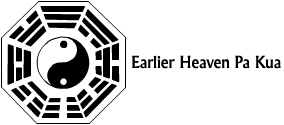
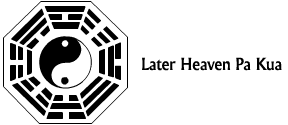
The Fundamentals of Feng Shui The Bagua The Bagua is the basis of many Feng Shui systems. "Bagua" means Eight Trigrams. These Eight Trigrams were derived from the study of the I-Ching. A trigram is a symbol of three lines, where a solid line is Yang and a broken line is Yin. Each Trigram embodies a series of meanings. The interaction and relationship between one trigram and another forms the fundamentals of Feng Shui study. TWO Baguas There are TWO types of Bagua. We have the "Xin-Tian Bagua" and the "Hou-Tian Bagua." The former relates to what is called the "Earlier Heaven Bagua" which exemplifies a perfect and harmonious universe. The latter refers to the "Later Heaven Bagua" which depicts an evolving and ever changing universe.
The difference between the 2 Baguas Look at the arrangement of the Trigrams around the Tai-Chi. The Earlier heaven sequence has the Chien (three straight lines) on top, which symbolizes Heaven, and the Kun (three broken lines) at the bottom which symbolizes Earth. The Later Heaven arrangement shows the Li (only the middle line is broken) on top, which symbolizes Fire, and the Kan (only the middle line is solid) at the bottom, which symbolizes Water. The usage of the Bagua The Earlier Heaven Bagua is used as a study of the natural laws of Heaven and the Universe. Legend has it that the arrangement of the Trigrams was found on a legendary creature called the HeTu. It is a dragon headed horse. Note: This is the correct arrangement for any Bagua Mirror (refer to diagram). Pay attention also to the arrangement of ALL the trigrams. The Later Heaven Bagua is used to derive the formulas for all forms of Feng Shui for the living. As it describes the changing universe, it describes the world where time, space and matter interacts and exerts its influence upon the living. The study of the Later Heaven Bagua can unlock the secrets to the Earth. Legend has it that the Later Heaven Bagua arrangement was found from the secret markings of the Dragon Headed Tortoise called the Luo Shu, which emerged from the River Lo.
<<Previous Article | Next: Symbolism in Feng Shui>>
|
|||||||||||||||||||||||||||||||||
|
|
|||||||||||||||||||||||||||||||||